Wednesday, 23 March 2016

BOOK REVIEW: THE SCHOLARSHIP OF TEACHING AND LEARNING IN HIGHER EDUCATION - by Razia Mayet


BOOK REVIEW

TITLE: THE SCHOLARSHIP OF TEACHING AND LEARNING IN HIGHER EDUCATION: ON ITS CONSTITUTION AND TRANSFORMATIVE POTENTIAL
EDITORS: Shirley Booth and Laurie Woollacott

PUBLISHER: SUN Media under the imprint SUN PRESS. First edition 2015. SA Price: R250.00


The book introduces Earnest L. Boyer in 1990, as the creator of the concept of Scholarship of Teaching and Learning (SoTL) and goes on to show the historical and social evolution of the idea. The notion has grown to encompass many different views of the nature of SoTL since then. The book deals with the philosophical underpinnings that gave rise to SoTL and traverses thinking on the issue from Aristotle to the current times. The Aristotelian view that ‘Man by nature cannot be without others’ concurs with the African philosophy of Ubuntu and is reflected in the assumptions that underpin UNESCO's recommendations for Higher Education that, “Higher Education personnel …. are expected to enhance the observance in society of the cultural, economic, social , civil and political rights of all people.”

In the chapter “Invitational Pedagogy” by Teboho Pitso, he avers that, “The basis of developing the alternative pedagogy was mainly to restore students’ agentic and discretionary power through creating learning environments where students could engage in independent research.  Invitational dialogic constructions were central to these efforts.” He succinctly puts forward the case for SoTL and invitational learning in the creative approach he uses in his ‘learnshops’.

Chapters 4 will be of interest to those in teacher education specifically and those in the field of education generally. Laurie Woollacott presents an interesting case study in MEDIATED INTERACTION GROUPS (MIGs). His findings suggest that this innovative pedagogy (MIG) has a potential impact on educational practice.

The rest of the chapters consider SoTL and transformation through a range of pedagogical approaches in the Health Sciences, Engineering, Teacher Education and in Academic Development. Overall the book is an interesting account of the historical and philosophical aspects of SoTL together with real pedagogical experiences of academics in the field. It confirms for those of us in higher education that we influence, just as much as we are influenced by those with whom we converse at a given moment and that our influences range over the scope of the human condition – morals, habits and the political condition.

In the final chapter, the editors, Booth and Woolacott summarize by considering the five  core domains and two contextual domains of SoTL. The core domains are: didactic, epistemic, social, moral and ethical and finally societal. The contextual domains are the disciplinary and professional.

They conclude that SoTL has a bearing on the status of the profession and the potential for its transformation, at the individual, the institutional and the societal levels.

For those who want a deeper understanding of where SoTL started, and where it is now, the first chapter is lovely. it is also useful for those who want to incorporate it into their teaching, and to make teaching more invitational, this is a book to buy.

Thursday, 3 March 2016

POSTHUMANIST PERSPECTIVES ON HIGHER EDUCATION PEDAGOGY


An ethics of becoming in a pedagogy for social justice - by Dirk Postma from Brenda Leibowitz                                                     

This presentation was by Dr. Dirk Postma, Faculty of Education, UJ, ON 25 Febr 2016. It included an analysis of the current problematic of neo-liberal dominance in higher education, the roots/tenets of posthumanist perspectices, and the implications for pedagogic practice.

Dirk Postma
Dirk’s session was well attended, the slides excellent, and the questions demonstrated serious engagement and appreciation for the issues raised.

The slides and presentation demonstrate neatly the philosophical method of inquiry – stating the problem, offering evidence of a problematic position, exposing the alternative worth consideration, structuring the dimensions of the counter argument, and illustrating the value of the counter argument.

The audience, at the Postgraduate Centre
It was good to be witness to Dirk's engagement with the posthumanist perspective – he’s well read, and could help the audience with their questions about the topic. (Sorry I couldn’t jump in, since I volunteered to make notes for this brief report.)

Dirk’s sharing of his inquiry into the value of the Posthumanist perspective for Social Justice pedagogy surely add much value to SOTL’s project of the advancement of notions and practices of SJP.

My rereading of the slides strengthened my inquiry into teacher education and professional learning, realizing that I need to stay with the following questions for time to come:
. What does it mean to be contextually aware? [of forces shaping our lives as academics in a Neoliberal era – what governs our work directly and indirectly?][slide 5].
.  In doing research and working with students UJ – what is the significance and possibility of each and every event/meeting/class – to help us understand how life is relative, progressing/becoming, and how it helps us grow as human beings?
. On the level of pedagogic practice – what strategies / actions / conversations are associated with becoming minoritarian? To affect and be affected? And work with desire and will to become different?
Gert van der Westhuizen - on the right
. In the case of each learning conversation with colleagues and students – how is power and desires used to affect the other? How are interactions used to constitute the self? [and so on].

Apart from these questions relevant to my own work at UJ, Dirk’s presentation elicited more than 15 questions from colleagues – needing further clarification, confirming key points, and raising new questions.

Gert van der Westhuizen


Tuesday, 1 March 2016

First Seminar at UJ: Decolonizing the Curriculum, Teaching and Learning at UJ


UJ kicked off its seminar series on decolonizing the curriculum in the library today. It was well attended, with a fabulous panel, and Cheryl Hendricks in the chair. Desiree Lewis from the University of the Western Cape began by saying that it is important how we define hegemonic knowledges. By way of example,  decolonization does not mean replacing all existing canons with new Afrocentric canons, if these should be equally exclusive, elitist or authoritarian. Similarly, replacing (all) knowledge from the North with knowledge from the South ignores the fact that knowledge can be hybridised and intermingled. Also problematic, according to Desiree, is to pepper the existing canon with new names, thus keeping the existing canon, which just looks a little more 'quirky'. What is more important is to get students to think critically about epistemology, where the knowledges come from, what the implications of the epistemologies are, and to think through the relationship of knowledge and power. Students need to explore knowledges, not just rote learn what is 'politically correct'. 
An interesting perspective from Alina Segobye, who trained first in the study of African languages, then in archeology, was how scientists can be so positivist. She illustrated her point with reference to the astrophysicists in South Africa, who attract large sums of money and occlude the work of afrocentric physicists. Indigenous Knowledge System (IKS) projects do not receive the kind of money other projects do. She said poignantly, it is not just about the present, but the pasts and the knowledges lost that one wants to reclaim.  (One would really like to have had more time to listen to these speakers, and I am sure I can't do them justice either in this potted summary.)  Tshepo Moloi from the UJ SRC acknowledged how the students have pushed the agenda to make us/the audience confront the violent practices in every lecture hall they go to. Further, he felt that the students' struggle at least got the topic of decolonizing the curriculum, to the point of today's session. He said there is nothing wrong with the current discourses, but "please let us see ourselves within the degrees that are taught - otherwise UJ - how is it an African university?"

Nelson Maldonado-Torres is another speaker whom I would not be able to do justice to, by summarizing his words. He introduced his own views by sharing with us, that he is from Puerto Rico, one of the oldest colonies in the world. And yet in South Africa many, white and black, view him as white, and reveal things they might not otherwise do, which gives him an unusual perspective on the local situation. He maintains that decolonializing generates anxiety because it unsettles one's sense of wellbeing and belonging, and in this way generates forms of bad faith. It is brutal because it calls identities into question, it calls the enlightenment into question. He made a distinction between colonialism over the past 500 years and the period before that. Colonialism over the recent past celebrates newness and secularism, over colonized and condemned subjects. He argued for the need to decriminalize student activism, and to see students as epistemological agents of change. Structural changes need to happen to empower students, as they are not unified and lack resources. Empower them and they will become sources of knowledge.

The time for panelists was running out so Nyasha Mboti made a dramatic input about the fact that the colony is a fiction, a lie, but one that remains extremely destructive. Related to this, given the myths that are perpetuated by colonialists, "knowledge is an active production of ignorance". Vineet Thakur spoke last, with some sobering realities from the Indian context where the romanticisation of the precolonial past (despite patriarchy and the caste system) has prompted the nationalist government to exercise oppressive actions agains those who criticize it, charging one student with sedition. For him, "decolonialisation involves continuous critique, a dialectical engagement".

Student contributions were lively and rambunctious, including comments that white intellectuals can learn from black thinkers; intellectuals should be more practical and side with the workers (rather than pontificate?); 'if you are choking me you are too close and are suffocating me, you feel the violence of my decolonization'. 'Africanity can be pretentious' And many more. During the wrap up, Nelson shared the importance of being able to learn from others, from many knowledges. Tshepo reminded that we should not be too polarizing, and should listen to each other. Cheryl, from the chair, emphasized that we can talk, but we need to go forward. This was the first of a five panel series. It was very lively and thoughtful, one just hopes that the series maintains a momentum, and that all colleagues and students who attend, get to express themselves, so that at UJ we can have a
 genuine engagement - especially if we really do want to decolonize the curriculum, as this requires much sharing, much collaboration, and hopefully some risk taking.

Wednesday, 17 February 2016

Seminar with Black Thought - Posting by Bongani Mashaba

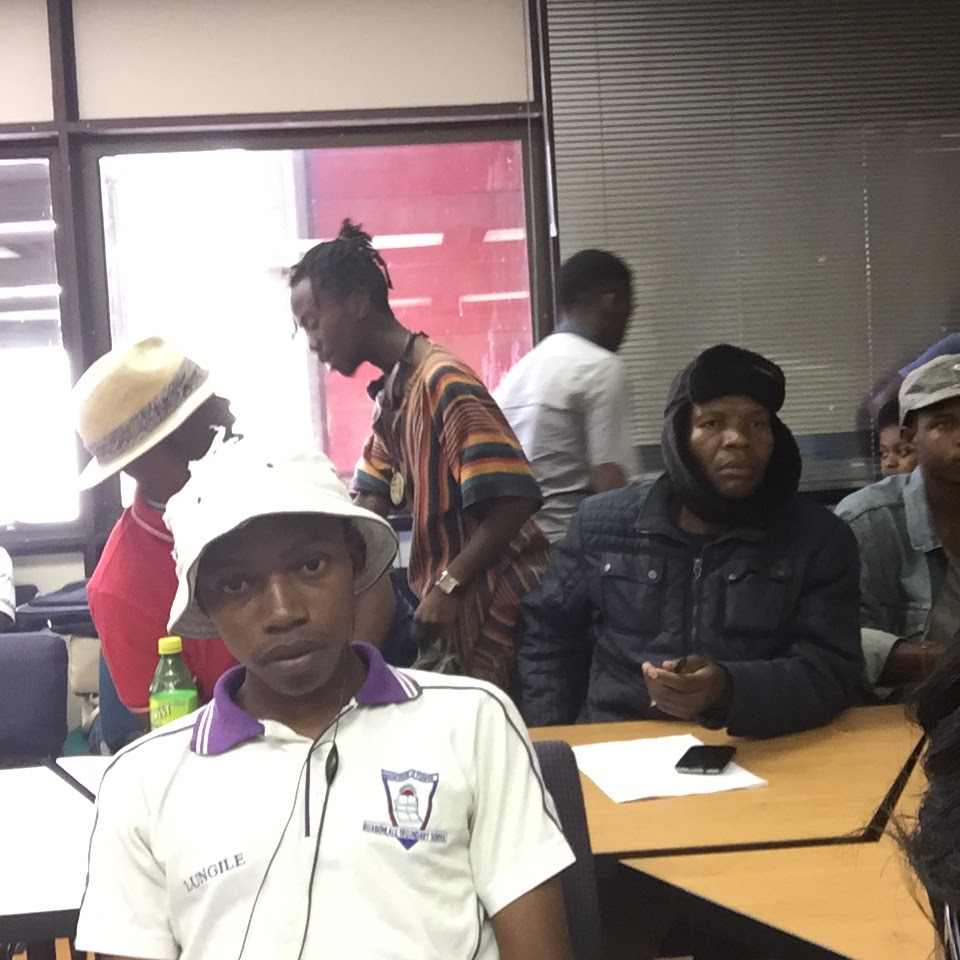
Black Thought members each shared their understanding
The emergence of the Rhodes Must Fall Movement at the University of Cape Town in 2015, seems to have raised an ancient, convoluted and contentious issue of decolonizing the public spaces, university systems and the goods- knowledge that the academy disseminates. Since the students-led protests, ‘decolonizing’ as a concept has once again become popular in the country as it was in the 1960’s and 1970s. “Various commentators (students, staff as well as academics from other institutions) have since used a number of platforms to grapple with questions such as what decolonisation means for a university in Africa, and where the process must begin” (Monday Monthly, UCT newspaper, 2015). With the debates now becoming even more heated, SOTL@UJ hosted the movement, Black Thought UJ on the 11th February 2016 under the theme ‘An encounter with black thought’ to have both academic staff and students share their thoughts on the matter.
Black Thought UJ describes itself “as movement geared towards championing the needs of blacks through the process of decolonizing the academic institution in its many facets”- ‘to disrupt the space’ as charged by Mr. Tsepo Moloi, the founding member of the group. The movement is inspired by the activities and the movements of the late 1960’s to1970’s who initially called for the overall decolonizing of the education system and public spaces.   

In this presentation different members of Black Thought UJ shared their own views and understanding of decolonization in the context of higher education South Africa and specifically for UJ. For Black Thought UJ decolonization entails a full recognition of black people from the language they speak, the cultures they practice, consideration of African content in the curriculum and being seen or regarded as equals to other races.

The group conceives the above as the epitome of their advocacy on the basis that UJ as institution is yet to transform. Rather, they believe UJ continues to perpetuate violence based on the appearance of materialism and privileges advanced through for example language usage. The group argues that African language departments are under-resourced when compared to other departments. As one member of Black Thought commented ‘Other departments even have modern couches, TV’s while African languages departments are more of museums with old ancient broken furniture’. This alone speaks to how such departments are under-valued and place people studying in such departments as inferior. The introduction of the online application and registering system is also seen as a deliberate attempt by the university to exclude black people as the university is well aware of the fact that many people on the outskirts do not have the necessary resources to access the online system. Thus, going on with the system shows which side the university leans on the most. The university is further accused of double standards in its language policy. It recognizes four languages; English, IsiZulu, Sepedi and Afrikaans yet when it comes to teaching and learning, English and Afrikaans are preferred medium of instruction. This practice is therefore an extension of privileges which are solely reserved for few individuals while the rest have to switch from mother tongue to English as medium of instruction despite their languages being officially recognized by the institution. This is considered grossly unfair based on the fact that students in Afrikaans classes are few and get to be taught, read academic texts in their language and express themselves in their mother tongue.
While the institution was under  heavy scrutiny, black academics were also not spared. There is a feeling from the group that having to deal with the institution and its unfavorable policies the other challenge they facing are black academics who seem to have forgotten about the struggle of a black child. A black student not from Black Thought that some white academics are more sympathetic towards black students while the same cannot be said about ‘those who supposed to understand them better’.
Given these institutionalized inequalities and refusal or failure from the university to lead the agenda of decolonizing the academy, Black Though UJ sought to concientize black students to understand themselves as the ‘black subjects’ by critically engaging with self and celebrate Africanism from language, culture to black thinkers while also advocating for a non-racial UJ.

While the views posited by the group were largely welcomed by the students present, few academic staff felt that the tone was too harsh and dismissive especially to white people as the impression given was that decolonizing was a fight against white people, to replace existing western cannons with African cannons without being critical. Some academics cautioned about the over generalization in the group’s view and argued that as much as their argument is sound but there is a need to theorise arguments than speaking from thin air.  

Brenda from SOTL @ UJ and Tshepo from Black Thought -who led the session
On closing, while decolonizing is a very sensitive issue and others consider Black Thought’s views as controversial, one notes that the seminar was a necessary platform for sharing ideas which need to be repeated with sufficient time allocated in a big open venue. Issues pertaining to decolonizing curriculum, public spaces and race are extremely uncomfortable as they are rooted in the particularities of certain histories, cultures and national habits and aspirations (See Reid, 1998). Thus, any discussion whether constructive or not will always ruffle feathers. As for UJ, Black Thought has fired the first shot, the space has been disrupted. If the academy is still a place “where a sense of identity, place, and worth is informed and contested through practices, which organize knowledge and meaning” then Black Thought UJ has set the wheels in motion to confront these topics of discomforts (Giroux, 1992:90). Whether we agree with them or not, the current atmosphere in higher education South Africa is so volatile in such a way that the revolution can no longer be put on hold for any longer.    

Monday, 1 February 2016

(K)nowledge or (k)nowledges in African universities?


Amasa Ndofirepi, University of Johannesburg
The discourse of a fitting curriculum knowledge base for university education in Africa has taken centre –stage in academic and socio-political circles although sceptics and gatekeepers would always want to shut out the entry of such debates in scholarly forums. Picking up from last Thursday’s SOTL @ UJ discussion forum of the YouTube recording of Boaventura de Sousa Santos' works and my reading of his Another Knowledge is possible : beyond Northern epistemologies (2008), I acknowledge how African universities have not been spared from the remnants of irrelevance left behind by colonialism.  African universities, as institutions of higher learning and nerve centres of knowledge production and distribution, have also been dragged into the challenges of the politics of knowledge, including contestations around development, empowerment, transformation and democracy. Regrettably, governments in Africa have set up universities that have abandoned the project of dispensing new directions for the genuine emancipation and liberation of the African continent. Knowing what and knowing how in African universities have come about through studying texts might be relevant in the US or Europe but are often divorced from African experiences and priorities. What I want to make a case for is the idea of how knowing what ( as propositional knowledge ) and knowing how in current university curriculum are dictates of the prescriptions of texts that contain materials that have western origins. In other words, to know is to appreciate the contents of materials that are confirmed in western- centric texts and the reverse can also be said to be true. Put simply, African experiences currently have little contribution to make in the formulation of what true knowledge is in the African universities. A puzzle of an epistemological nature is: how should the knowledge acquisition process enlighten worthwhile dispositions and qualities that products of African universities should exhibit? Conversely, is Africanisation of knowledge in the university the most appropriate panacea to the socio-economic development challenges afflicting Africa in this era of the much celebrated neo-liberal and globalisation discourse?

 In pursuit of the foregoing, is this what recent student protests in South African universities meant when, in their Fees must fall campaign, they referred to “a lack of African content in the curriculum?” Could it be one way of speaking out against exclusionary, elite-dominated university curriculum policy makers bent to eliminate the majority from the theatre of recognition of other knowledge producers? Although some may argue that students are following blindly the politics of knowledge, dos Santos, (2004) would defend their actions as "resistance against hegemonic globalisation” which place western scientistic knowledge forms and sources on pole positions in the hierarchical knowledge pyramid. This view endorses the presence of what dos Santos refers to as the  “monocultures of knowledge" (ibid).    But are there some (K)nowledges that reign supreme above other (k)nowledges? Yet another pedestrian question could be: do university students know what they are supposed to learn and know ahead of their lecturers as the former attempt to separate the different forms and sources of knowledge? All these epistemological questions, I argue, revolve around the politics of knowledge and the puzzle of whose knowledge matters in the African university in the 21st century. I find the readings of dos Santos’ works  appropriate  to the debates revolving around the decolonisation of knowledges in the African university as long as proponents are constantly reminding themselves that Africa, as a continent and the institutions therein, are circumscribed by the global knowledge economy which is difficult to resist and shake off in the 21st century.


Friday, 4 December 2015

SOTL @ UJ Mini-Conference 1 December 2015

The SOTL @ UJ: Towards a Socially Just Pedagogy project held a mini-conference on 1 December, attended by about 40 people. There were various highlights during the day. The first was the keynote by Michalinos Zembylas from the Open University of Cyprus.
His talk, entitled: Conceptualizing 'socially just pedagogies' through the lens of 'new pedagogy studies' and in the aftermath of the 'affective turn' was the first highlight. He shared some thoughts on new pedagogy studies, which highlight the importance of pedagogy as relational; the relationship of culture, pedagogy and power; and a focus on the public sites of pedagogy. For me an important issue he drew our attention to, is that normal pedagogies can have 'collateral damage'. If this is the case, we have no option but to pay attention to what we are doing in the classroom and beyond. An exciting dimension to the talk was the focus on what the affective turn has to offer. This focus ruptures the dichotomy between the social and the psychic. It discusses practices, individual experiences and historically situated affects. Psychic elements are relationally entangled with historical and internal developments (and if you want to read more, do go to Michalinos' papers or books, of which there are several!)
Some of us who stayed to the end of the day

A second highlight was the incredible participation of all present, in particular, the papers presented. These were on varied topics such as feedback to student writing and the ideas of Nancy Fraser on participatory parity; the importance of SOTL as a vehicle to advance socially just pedagogies; cognitive justice; postgraduate participation and equity and participation; dominant discourses of tutors; and perceptions of students about hand held devices in relation to issues of equity. We also deliberated our own draft conceptual framework about SOTL and socially just pedagogy. A key issue emphasized in that discussion is that socially just pedagogies are partly about process and deliberation - it is not something that is ever finalized. A related point was that if teaching and learning are about encouraging criticality, creativity and independent thought, then so should the environment be, in which academics engage with each other about matters of teaching and learning, the curriculum and their own development. This has important implications for a university to ensure that the climate for dialogue is open and encouraging of diverse opinions.

A third highlight was the closing session. Here Leila Kagee from the Faculty of Education concluded her comments by reading to us a beautiful poem, included here.
Finally Michalinos presented us with an important set of questions to challenge and trouble ourselves, and to ask, are our teaching interventions really an example of socially just pedagogies. Michalinos' opening presentation and closing response are provided at the end of this blog entry.

Encouraging words in the welcoming by the DVC Academic, Angina Parekh, were that the University recognizes the importance of SOTL and even the NRF is beginning to recognize this. She did point out, however that the field appears to be dominated by women, and that perhaps the issue of gender is one that should be taken up in further discussions. The SOTL @ UJ project will enter its third year in 2016. Given the focus on social justice (or the lack thereof) in higher education in South Africa, the deliberations in 2016 will be extremely important, and we hope to have many participants at the seminar series. (The plan for the 2016 series is available in the right-hand link on the blog).


Wednesday, 21 October 2015

“Thank you for making race not feel like walking on eggs and for injecting humour” : teaching race at Stellenbosch


In this presentation Rob Pattman shared his approach to teaching race using a participatory pedagogy. One of the explicit goals that Rob set for the module was to engage with transformation more reflexively and coherently, against the backdrop of a predominantly white institution. He intentionally sought to critique the common tendency for transformation to be reduced to numbers and superficially ‘embracing diversity’. While recent student protests on institutional transformation attest to the importance of ensuring that institutions are representative of the broader society, focusing only on numbers can lead to the ‘fetishisation’ of race.

Rob Pattman
The strategy adopted was to invite students to become knowledge producers by making their own stories and lives as well as their own conceptualisations of race central topics in the module. In this sense he is able to encourage students to move beyond the black, coloured and indian student as ‘diverse other’ to compelling all students to be knowledge producers.  Using humour, provocation and asking seemingly naïve questions such as how would you describe race to an alien from another planet, he got students to problematize race and see the absurdity in the constructions of race. The notion of race as something that is constructed but also as something that produces us, resonates with us. This is useful because it provokes us to shift the focus from race as being something we have, to race as something we do (race as performativity). The performativity attached to race engenders in all participants in the module a sense of agency and more importantly it creates the space for those who experience racism to set the agenda.

Rob acknowledges that humour could result in trivialising and reproducing racial stereotypes if not dealt with sensitively. However, humour does help with engaging with ‘troubling topics’ and subverting categories which are normally reified and taken for granted.  The positive responses from students about the module are testimony to the value of the approach in extending and nuancing student understandings of race and racism. This enriched student understanding of, amongst other things, race as materiality; race as spatially differentiated (living and recreational spaces); race as a verb involving processes of identifications and dis-identification and race as troubling as well as something that should be troubled. By using movies such as Skin  and Luister as well as the stories of individuals such as Robertson and Wesley Rob skilfully illustrates the parallels between and intersectionality of race with gender, class, sexuality, age etc. in the social construction of student identifications and expressions of power and inequality.  

As all good presentations do, Rob’s approach to engaging with race left participants in the seminar with more questions. Questions relating to the theories that underpin this approach, the use of humour in productive ways, more details on learning tasks that encourage student to value their own experiences, create knowledge and to be agents of transformation were just some of them. We would like to invite other participants in the workshop and Rob to extend the dialogue.

Blog authors: Kibbie Naidoo and Vanessa Merckel