Wednesday, 17 February 2016

Seminar with Black Thought - Posting by Bongani Mashaba

Black Thought members each shared their understanding
The emergence of the Rhodes Must Fall Movement at the University of Cape Town in 2015, seems to have raised an ancient, convoluted and contentious issue of decolonizing the public spaces, university systems and the goods- knowledge that the academy disseminates. Since the students-led protests, ‘decolonizing’ as a concept has once again become popular in the country as it was in the 1960’s and 1970s. “Various commentators (students, staff as well as academics from other institutions) have since used a number of platforms to grapple with questions such as what decolonisation means for a university in Africa, and where the process must begin” (Monday Monthly, UCT newspaper, 2015). With the debates now becoming even more heated, SOTL@UJ hosted the movement, Black Thought UJ on the 11th February 2016 under the theme ‘An encounter with black thought’ to have both academic staff and students share their thoughts on the matter.
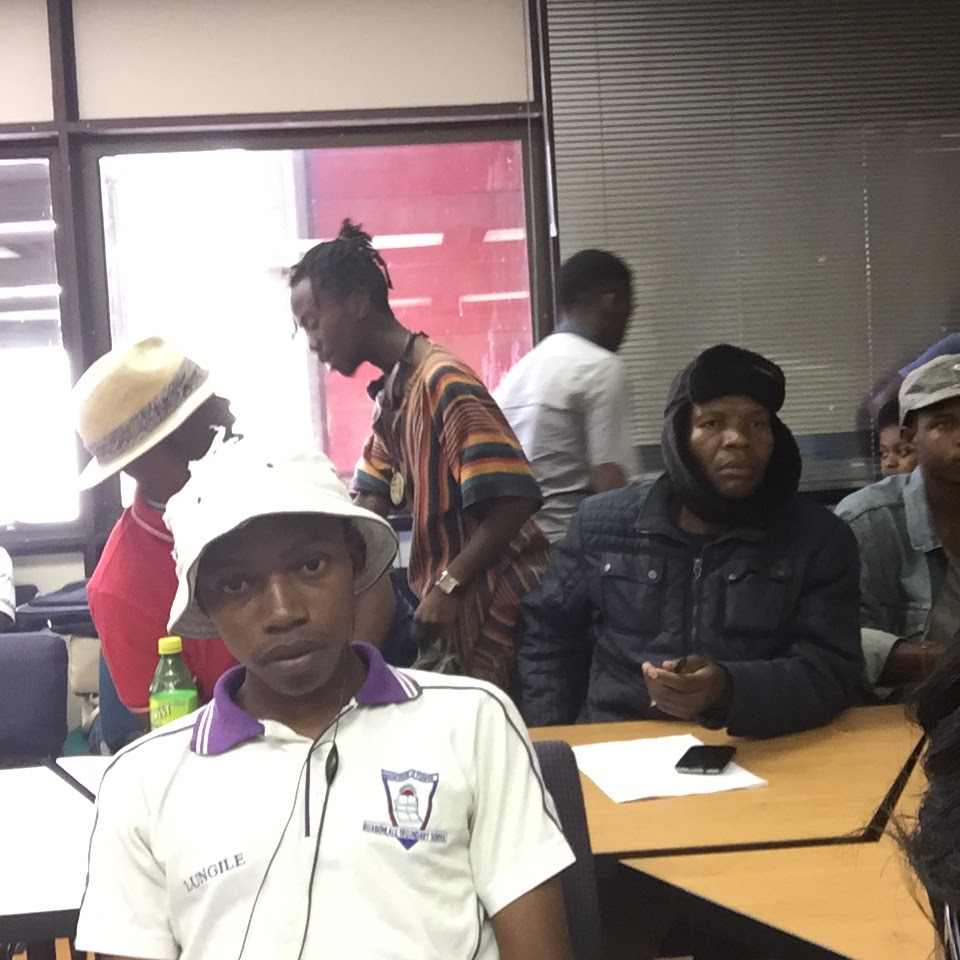
Black Thought UJ describes itself “as movement geared towards championing the needs of blacks through the process of decolonizing the academic institution in its many facets”- ‘to disrupt the space’ as charged by Mr. Tsepo Moloi, the founding member of the group. The movement is inspired by the activities and the movements of the late 1960’s to1970’s who initially called for the overall decolonizing of the education system and public spaces.   

In this presentation different members of Black Thought UJ shared their own views and understanding of decolonization in the context of higher education South Africa and specifically for UJ. For Black Thought UJ decolonization entails a full recognition of black people from the language they speak, the cultures they practice, consideration of African content in the curriculum and being seen or regarded as equals to other races.

The group conceives the above as the epitome of their advocacy on the basis that UJ as institution is yet to transform. Rather, they believe UJ continues to perpetuate violence based on the appearance of materialism and privileges advanced through for example language usage. The group argues that African language departments are under-resourced when compared to other departments. As one member of Black Thought commented ‘Other departments even have modern couches, TV’s while African languages departments are more of museums with old ancient broken furniture’. This alone speaks to how such departments are under-valued and place people studying in such departments as inferior. The introduction of the online application and registering system is also seen as a deliberate attempt by the university to exclude black people as the university is well aware of the fact that many people on the outskirts do not have the necessary resources to access the online system. Thus, going on with the system shows which side the university leans on the most. The university is further accused of double standards in its language policy. It recognizes four languages; English, IsiZulu, Sepedi and Afrikaans yet when it comes to teaching and learning, English and Afrikaans are preferred medium of instruction. This practice is therefore an extension of privileges which are solely reserved for few individuals while the rest have to switch from mother tongue to English as medium of instruction despite their languages being officially recognized by the institution. This is considered grossly unfair based on the fact that students in Afrikaans classes are few and get to be taught, read academic texts in their language and express themselves in their mother tongue.
While the institution was under  heavy scrutiny, black academics were also not spared. There is a feeling from the group that having to deal with the institution and its unfavorable policies the other challenge they facing are black academics who seem to have forgotten about the struggle of a black child. A black student not from Black Thought that some white academics are more sympathetic towards black students while the same cannot be said about ‘those who supposed to understand them better’.
Given these institutionalized inequalities and refusal or failure from the university to lead the agenda of decolonizing the academy, Black Though UJ sought to concientize black students to understand themselves as the ‘black subjects’ by critically engaging with self and celebrate Africanism from language, culture to black thinkers while also advocating for a non-racial UJ.

While the views posited by the group were largely welcomed by the students present, few academic staff felt that the tone was too harsh and dismissive especially to white people as the impression given was that decolonizing was a fight against white people, to replace existing western cannons with African cannons without being critical. Some academics cautioned about the over generalization in the group’s view and argued that as much as their argument is sound but there is a need to theorise arguments than speaking from thin air.  

Brenda from SOTL @ UJ and Tshepo from Black Thought -who led the session
On closing, while decolonizing is a very sensitive issue and others consider Black Thought’s views as controversial, one notes that the seminar was a necessary platform for sharing ideas which need to be repeated with sufficient time allocated in a big open venue. Issues pertaining to decolonizing curriculum, public spaces and race are extremely uncomfortable as they are rooted in the particularities of certain histories, cultures and national habits and aspirations (See Reid, 1998). Thus, any discussion whether constructive or not will always ruffle feathers. As for UJ, Black Thought has fired the first shot, the space has been disrupted. If the academy is still a place “where a sense of identity, place, and worth is informed and contested through practices, which organize knowledge and meaning” then Black Thought UJ has set the wheels in motion to confront these topics of discomforts (Giroux, 1992:90). Whether we agree with them or not, the current atmosphere in higher education South Africa is so volatile in such a way that the revolution can no longer be put on hold for any longer.    

Monday, 1 February 2016

(K)nowledge or (k)nowledges in African universities?


Amasa Ndofirepi, University of Johannesburg
The discourse of a fitting curriculum knowledge base for university education in Africa has taken centre –stage in academic and socio-political circles although sceptics and gatekeepers would always want to shut out the entry of such debates in scholarly forums. Picking up from last Thursday’s SOTL @ UJ discussion forum of the YouTube recording of Boaventura de Sousa Santos' works and my reading of his Another Knowledge is possible : beyond Northern epistemologies (2008), I acknowledge how African universities have not been spared from the remnants of irrelevance left behind by colonialism.  African universities, as institutions of higher learning and nerve centres of knowledge production and distribution, have also been dragged into the challenges of the politics of knowledge, including contestations around development, empowerment, transformation and democracy. Regrettably, governments in Africa have set up universities that have abandoned the project of dispensing new directions for the genuine emancipation and liberation of the African continent. Knowing what and knowing how in African universities have come about through studying texts might be relevant in the US or Europe but are often divorced from African experiences and priorities. What I want to make a case for is the idea of how knowing what ( as propositional knowledge ) and knowing how in current university curriculum are dictates of the prescriptions of texts that contain materials that have western origins. In other words, to know is to appreciate the contents of materials that are confirmed in western- centric texts and the reverse can also be said to be true. Put simply, African experiences currently have little contribution to make in the formulation of what true knowledge is in the African universities. A puzzle of an epistemological nature is: how should the knowledge acquisition process enlighten worthwhile dispositions and qualities that products of African universities should exhibit? Conversely, is Africanisation of knowledge in the university the most appropriate panacea to the socio-economic development challenges afflicting Africa in this era of the much celebrated neo-liberal and globalisation discourse?

 In pursuit of the foregoing, is this what recent student protests in South African universities meant when, in their Fees must fall campaign, they referred to “a lack of African content in the curriculum?” Could it be one way of speaking out against exclusionary, elite-dominated university curriculum policy makers bent to eliminate the majority from the theatre of recognition of other knowledge producers? Although some may argue that students are following blindly the politics of knowledge, dos Santos, (2004) would defend their actions as "resistance against hegemonic globalisation” which place western scientistic knowledge forms and sources on pole positions in the hierarchical knowledge pyramid. This view endorses the presence of what dos Santos refers to as the  “monocultures of knowledge" (ibid).    But are there some (K)nowledges that reign supreme above other (k)nowledges? Yet another pedestrian question could be: do university students know what they are supposed to learn and know ahead of their lecturers as the former attempt to separate the different forms and sources of knowledge? All these epistemological questions, I argue, revolve around the politics of knowledge and the puzzle of whose knowledge matters in the African university in the 21st century. I find the readings of dos Santos’ works  appropriate  to the debates revolving around the decolonisation of knowledges in the African university as long as proponents are constantly reminding themselves that Africa, as a continent and the institutions therein, are circumscribed by the global knowledge economy which is difficult to resist and shake off in the 21st century.


Friday, 4 December 2015

SOTL @ UJ Mini-Conference 1 December 2015

The SOTL @ UJ: Towards a Socially Just Pedagogy project held a mini-conference on 1 December, attended by about 40 people. There were various highlights during the day. The first was the keynote by Michalinos Zembylas from the Open University of Cyprus.
His talk, entitled: Conceptualizing 'socially just pedagogies' through the lens of 'new pedagogy studies' and in the aftermath of the 'affective turn' was the first highlight. He shared some thoughts on new pedagogy studies, which highlight the importance of pedagogy as relational; the relationship of culture, pedagogy and power; and a focus on the public sites of pedagogy. For me an important issue he drew our attention to, is that normal pedagogies can have 'collateral damage'. If this is the case, we have no option but to pay attention to what we are doing in the classroom and beyond. An exciting dimension to the talk was the focus on what the affective turn has to offer. This focus ruptures the dichotomy between the social and the psychic. It discusses practices, individual experiences and historically situated affects. Psychic elements are relationally entangled with historical and internal developments (and if you want to read more, do go to Michalinos' papers or books, of which there are several!)
Some of us who stayed to the end of the day

A second highlight was the incredible participation of all present, in particular, the papers presented. These were on varied topics such as feedback to student writing and the ideas of Nancy Fraser on participatory parity; the importance of SOTL as a vehicle to advance socially just pedagogies; cognitive justice; postgraduate participation and equity and participation; dominant discourses of tutors; and perceptions of students about hand held devices in relation to issues of equity. We also deliberated our own draft conceptual framework about SOTL and socially just pedagogy. A key issue emphasized in that discussion is that socially just pedagogies are partly about process and deliberation - it is not something that is ever finalized. A related point was that if teaching and learning are about encouraging criticality, creativity and independent thought, then so should the environment be, in which academics engage with each other about matters of teaching and learning, the curriculum and their own development. This has important implications for a university to ensure that the climate for dialogue is open and encouraging of diverse opinions.

A third highlight was the closing session. Here Leila Kagee from the Faculty of Education concluded her comments by reading to us a beautiful poem, included here.
Finally Michalinos presented us with an important set of questions to challenge and trouble ourselves, and to ask, are our teaching interventions really an example of socially just pedagogies. Michalinos' opening presentation and closing response are provided at the end of this blog entry.

Encouraging words in the welcoming by the DVC Academic, Angina Parekh, were that the University recognizes the importance of SOTL and even the NRF is beginning to recognize this. She did point out, however that the field appears to be dominated by women, and that perhaps the issue of gender is one that should be taken up in further discussions. The SOTL @ UJ project will enter its third year in 2016. Given the focus on social justice (or the lack thereof) in higher education in South Africa, the deliberations in 2016 will be extremely important, and we hope to have many participants at the seminar series. (The plan for the 2016 series is available in the right-hand link on the blog).


Wednesday, 21 October 2015

“Thank you for making race not feel like walking on eggs and for injecting humour” : teaching race at Stellenbosch


In this presentation Rob Pattman shared his approach to teaching race using a participatory pedagogy. One of the explicit goals that Rob set for the module was to engage with transformation more reflexively and coherently, against the backdrop of a predominantly white institution. He intentionally sought to critique the common tendency for transformation to be reduced to numbers and superficially ‘embracing diversity’. While recent student protests on institutional transformation attest to the importance of ensuring that institutions are representative of the broader society, focusing only on numbers can lead to the ‘fetishisation’ of race.

Rob Pattman
The strategy adopted was to invite students to become knowledge producers by making their own stories and lives as well as their own conceptualisations of race central topics in the module. In this sense he is able to encourage students to move beyond the black, coloured and indian student as ‘diverse other’ to compelling all students to be knowledge producers.  Using humour, provocation and asking seemingly naïve questions such as how would you describe race to an alien from another planet, he got students to problematize race and see the absurdity in the constructions of race. The notion of race as something that is constructed but also as something that produces us, resonates with us. This is useful because it provokes us to shift the focus from race as being something we have, to race as something we do (race as performativity). The performativity attached to race engenders in all participants in the module a sense of agency and more importantly it creates the space for those who experience racism to set the agenda.

Rob acknowledges that humour could result in trivialising and reproducing racial stereotypes if not dealt with sensitively. However, humour does help with engaging with ‘troubling topics’ and subverting categories which are normally reified and taken for granted.  The positive responses from students about the module are testimony to the value of the approach in extending and nuancing student understandings of race and racism. This enriched student understanding of, amongst other things, race as materiality; race as spatially differentiated (living and recreational spaces); race as a verb involving processes of identifications and dis-identification and race as troubling as well as something that should be troubled. By using movies such as Skin  and Luister as well as the stories of individuals such as Robertson and Wesley Rob skilfully illustrates the parallels between and intersectionality of race with gender, class, sexuality, age etc. in the social construction of student identifications and expressions of power and inequality.  

As all good presentations do, Rob’s approach to engaging with race left participants in the seminar with more questions. Questions relating to the theories that underpin this approach, the use of humour in productive ways, more details on learning tasks that encourage student to value their own experiences, create knowledge and to be agents of transformation were just some of them. We would like to invite other participants in the workshop and Rob to extend the dialogue.

Blog authors: Kibbie Naidoo and Vanessa Merckel

Friday, 2 October 2015

The First International Conference on Scholarship of Teaching and Learning

The Central University of Technology (CUT) held the 1st International Conference on Scholarship of
The conference opened with a song
Teaching and Learning on 1 - 2 October 2015. This was a lively and well attended conference, mainly by academics at the University, though with colleagues from several neighboring universities as well. There were 5 keynote speakers, also from CUT and outside. Jane McKenzie gave a valuable
presentation of how SOTL is encouraged at the University of Glasgow and Merja Alanko-Turunen from the Haaga Helia University of Applied Science in Helsinki spoke about how pedagogic and reflective practice are advanced at her institution. She had some novel ideas that are worth considering. I have  embedded my own presentation, which showcases the work of the SOTL @ UJ project, and argues for a strongly social justice perspective on SOTL.


The Scholarship of Teaching and Learning - A social justice perspective from Brenda Leibowitz


Yunnus Ballim, the Vice-Chancellor at the new Sol Plaatje university, gave a talk entitled, "Reflecting epistemological access and the analytical frameworks guiding institutional responses to student learning in South African higher education". He was strongly critical of the way the term 'epistemological access is used', and the extended curriculum initiative and the many assumptions this initiative contains that he holds to be illogical. This echoes points made in an article by Leibowitz and Bozalek:  Leibowitz, B. and Bozalek, V. (2015) Foundation provision - A social justice perspective, South African Journal of Higher Education, 29 (1) 8 – 25.  He also makes the point that transformation is about excellence, and that a university that graduates deeply racist students for example the creators of the Reitz video at Free State University "cannot call itself a university". I am sure this is not meant to cast aspersions on the present leadership or situation at UFS, but rather, to make a rhetorical point about the purpose of the curriculum and graduate outcomes. 


Isaac Ntshoe gave a talk entitled "Theorizing Curricula and Pedagogy of Professional and Sector Fields of Practice: Beyond a metatheoretical discourse". He made a call for advantaging our students by giving them access to powerful (and theoretical) knowledge.
James Swart, Jane McKenzie, Mabokang Monnapula-Mapesela, me, Merja Alanko-Turunen and Isaac Ntshoe


The first day was chaired by James Swart from the Engineering Faculty. Evidence of his enthusiasm for teaching and SOTL is the fact that this year he has received a commendation from the CHE/HELTASA National Teaching Excellence Awards (there are five awards and six commendations). 

There were 48 papers in parallel sessions. Although some presentations were from colleagues from other universities such as the University of Fort Hare and the new University of Mpumalanga, the overwhelming majority were by academics at CUT. These are the result of a concerted strategy at the university to encourage the SOTL. It is an impressive strategy launched by the Dean of Academic Development and Support at CUT, Mabokang Monnapula-Mapesela, who made a presentation about this project. The project is managed by Isaac Ntshoe. Key components of the strategy is that academics apply to become participants in the scheme; they are entitled to certain developmental opportunities; they are assigned to a mentor; there is a series of workshops; and there was this conference itself. A special issue of the CUT-based journal, New Generation Sciences, is to follow. This strategy makes use of Teaching Development Grant funds. - It might be one that other universities wish to follow? 


Thursday, 24 September 2015

Boaventura de Sousa Santos, counter-hegemonic globalizations and cognitive justice - implications for teaching and learning

In the SOTL@UJ: Towards a Socially Just Pedagogy discussions we have considered many perspectives on social justice, critical theory and appropriate research methods, and have spent time - but possibly not enough - on the question of knowledge: whose knowledge, how do we approach knowledge for social justice, and what are the implications for teaching and learning? I recently came across the work of Bonaventura de Sousa Santos, who is Professor of Sociology at the University of Coimbra and Distinguished Legal Scholar at the University of Wisconsin-Madison. (Thanks to Sioux McKenna for a reference to his work.) His principal thesis is that western critical theory is 'tired', and that it has nothing new to offer. This clearly means we need to look elsewhere for inspiration - for example the global South, which rather than the geographic South, is a metaphor for wherever the disposessed live. The work of latin American writers who can show us the way forward are summed up in the concept of "nuestra America". de Sousa refers to the hegemonic globalization of western theories and knowledge as a form of 'epistemicide': in the academy and the capitalist knowledge economy we are destroying local and indigenous knowledges. It is worth listening to his talks, at:

http://www.havenscenter.org/vsp/boaventura-de-sousa-santos

An article I found which had lots of ramifications for social justice in higher education is:

Boaventura de Sousa Santos (2001) Nuestra America: Reinventing a subaltern paradigm of recognition and redistribution. Theory, Culture and Society, 18 (2-3) 185-217. (I have saved it in the project dropbox folder under "general readings: cognitive justice". )

The points that are particularly relevant for social justice in the higher education classroom are threefold:

The sociology of absences - rather than to continuously see the marginal classes as ignorant and dangerous, we have to be reflexively on the lookout for those silences and gaps imposed by the dominant knowledge practices. To me this has major implications for how we approach teaching and learning, and what we frequently talk about as 'epistemological access' - the knowledges to which our students do not enjoy access, and in whose thrall they are seen as ignorant.

The theory of translation - here one wants to see the mutual intelligibility between different concepts and struggles and oppressed groups, without homogenizing all struggles, or subsuming some under others.

The third step is manifesto practices,  or the principles of action that bring about alliances between different struggles. Significant here is the idea that there can be no recognition (achieved via a politics of difference) without redistribution (achieved via a struggle for equality). In the SOTL@UJ seminars last year we discussed the relationship of recognition and redistribution with reference to the writing of Nancy Fraser. This is a good point to bear in mind presently in South Africa, where on some campuses a struggle for recognition is more salient (e.g. Rhodes must fall) whereas at others, protests about access, fees and residence condition are more about a struggle for redistribution. There is a nice section in the article:

.. the notion of a fundamental meta-right: the right to have rights. We have the right to be equal whenever difference diminishes us; we have the right to be different whenever equality decharacterizes us (p. 193). 

This is a useful complementary view to that of the role of indigenous knowledge systems. We would need to think deeply of how we were to achieve this kind of listening, translating and recognizing of other worldview in our classes. Granted, our classrooms are not the same as the international arenas in which the struggles of the landless or oppressed are fought, but as the current tensions in South Africa that are playing themselves out at some of our universities are showing, our classrooms are by no means totally separated out from these broader societal struggles. If this is the case, how do we teach and research our teaching differently?


Thursday, 3 September 2015

SoTL and socially just pedagogies in the graphic arts

On Thursday 27th August three presenters: Elmarie Costandius, Mocke J van Veuren and Brenden Gray shared their reflections on socially just pedagogies in the graphic arts discipline. Elmarie Costandius, who coordinates the MA in Visual Arts (Art Education) at Stellenbosch University, presented a paper titled “Socially just pedagogy and community interaction: A reflection on practice”.  

Elmarie Costandius


Elmarie explored how community interaction served to unpack the silences around painful historical experiences. The module provided powerful learning opportunities for students to critically engage with difficult knowledge and dialogues. She shared students’ experiences of mental and bodily discomfort when dealing with sensitive issues, such as forced removals, and other painful historical narratives. Evidence from her study suggests that discomfort is potentially a catalyst for initiating critical self-reflection and change. What was valuable about this presentation was that it highlighted issues of difficult knowledge and dialogues and how these are often suppressed.  What also emerged was the need to grapple productively with the narratives of difficult knowledge even when these are inconclusive, incomplete and still emerging. Another important insight is that while no single or simple answer to complex experiences exist, teachers need to carefully create safe spaces in which students can explore their assumptions without necessarily coming to one specific or common conclusion. Teachers themselves also need to be open to interrogate their own difficult knowledge and practices.


Mocke J van Veuren
Mocke J van Veuren, an independent artist, experimental filmmaker, researcher and educator based in Johannesburg reported on “The Angry Youth Workshop: Exercising a politics of space through critical arts pedagogy”. In this presentation, he interrogated the forces and structures that govern or ‘police’ our sense of belonging or alienation and action in everyday spaces which are sometimes clearly visible, but could be hidden in plain sight. Drawing on Jacques Rancière’s notion of “policing” (the invisible rules of structures that govern) and “politics” as the act of making visible these structures and forces, Mocke was able to show that despite  the perceived freedom of movement post-1994, there is still a form of invisible “policing” of space and place that is less often examined and contested. Through the use of visual, associative and performative methodologies as tools for reflection and active intervention, students took pictures of assumed public spaces that had policing elements, serving to foster discomfort. In so doing, students become more aware of the link between their personal values and narratives linked to histories of space and place and how these potentially serve to constrain. One example of such was the photograph of the student praying outside the church surrounded by barbed wire.

Brenden Gray
Brenden Gray is an artist, graphic design educator, art critic and researcher at UJ. Brenden shared his specific approach to social justice education through working with undergraduate modules in the BA Communication design course. Framed by a discussion of social justice pedagogy, he related knowing and knowledge in dynamic and dialectical ways as he unpacked and critically interrogated his own practice. Providing students with conceptual tools informed by the work of Bourdieu and other critical theorists, he encouraged students to explore, critique and widen their socio-political reasoning within the disciplinary context of arts education. For example, students were encouraged to theorize and problematize issues such as taste, status and artistic self-representation. Valuable in this exploration was that it encouraged students to draw from their lived experience and link it to social class theory. This afforded them the space to engage critically with disciplinary knowledge and share their personal creative artefacts in response to specific social justice themes.

Respondent, Michael Cross
While quite different from each other, each presentation highlighted a number of issues for us to grapple with in the domain of the scholarship of teaching and learning in higher education. Each raises important issues for interrogating disciplinary knowledge and the pedagogy used in higher education to advance multiple and nuanced notions of social justice. In one form or another, they encourage us to explore not only what we teach, but also how we teach, and perhaps as importantly why we teach.  The highly contested, embodied and emotional investment in the transformation of the self and broader society through education argued in these presentations, extended and refined our understanding of, and work towards issues of distribution, recognition and transformation as argued by Fraser (1998). The presentations also provoked an exploration of how, as teachers, we teach in more ethical and responsible ways, especially when working with discomfort: our own, as well as our students’. Furthermore, it highlighted the necessity to become increasingly aware of the silences (and gaps) in our knowledge, curricula, and pedagogies as we seek to transform teaching and learning in
Blog authors: Ness Merckel and Bongani Mashaba
higher education. Unique in these presentations are that they begin to move social justice debates away from the strictly normative domains towards the often neglected analytical domains. This provide opportunities for challenging hegemonies and ultimately serves to foster a greater theorising of our practices in a more socially just manner, as called for by the respondent, Michael Cross.